

This China travel guide for foreigners covers all essential entry requirements and practical tips for first-time visitors to China.
Traveling to China for the first time is an exciting adventure.In this guide, foreign visitors can clearly understand entry rules, must‑have apps, top cities, and local customs for a safe and smooth trip.

1. Essential Entry Requirements for Foreigners in China
Complete the Electronic Entry Card in Advance
During your flight or before landing, scan the airline QR code to fill out the electronic entry card.
Save the customs QR code screenshot on your phone.
This small step will greatly speed up your arrival process.

Required Documents for Entry
To avoid problems at immigration, prepare these items:
- Valid passport with enough remaining validity
- Valid Chinese tourist visa (if needed)
- Passport and travel itinerary for 240-hour transit visa exemption
Step-by-Step Arrival Process
First, follow airport signs for Arrival.
Next, complete fingerprint and facial recognition checks.
Then, show your passport and documents at border control.
After that, collect your checked luggage.
Finally, pass through final customs inspection.

2. Must-Have Apps for Traveling in China
Payment & Communication Apps
In terms of payment, Alipay and WeChat Pay are the most widely used methods in China.
You can easily link international Visa, Mastercard, and other credit cards.
Meanwhile, a local SIM card from China Mobile or China Unicom ensures stable internet access.
Navigation & Transportation Apps
- Gaode Map or Baidu Maps: Best for directions, buses, subways, and ride‑hailing.
- 12306 China Railway: Official app for booking high‑speed train tickets.
Translation Apps
To overcome language barriers, use Google Translate or Baidu Translate for instant camera translation.
This feature helps with menus, street signs, and daily conversations.

3. Best Cities to Visit in China for First-Timers
Top Recommended Destinations
Harbin: Ice sculptures, snow towns, and European-style architecture.

Beijing: Forbidden City, Great Wall, traditional hutongs, and modern skyline.

Quanzhou: Maritime Silk Road history and local cultural charm.

Xiamen: Coastal scenery, relaxed vibe, and fresh seafood

Beihai: Quiet beaches, volcanic islands, and great value for travelers.

Chongqing: 8D mountain city, unique views, and famous spicy hot pot.

Sanya: Tropical beaches and warm winter weather.

Kunming: Year‑long mild climate and wild mushroom hot pot.

Luoyang: Ancient capital, Buddhist art, and beautiful Tang‑style night scenery.

- Chengdu: 🌟 The Perfect Nomad & Cultural Hub
Why visit? Famous for its relaxed pace of life (“Ba Shi”), cute Giant Pandas, and ancient tea plantations. It is the ideal base for digital nomads who want a mix of city comforts and traditional Chinese culture.

4. Essential China Travel Tips for Foreign Visitors
Money & Payment
Although mobile payment is extremely convenient in China,
it is still wise to carry a small amount of cash for remote areas and small shops.
Tipping & Local Etiquette
In China, tipping is not common or expected.
In fact, service charges are already included in most bills.
Daily Life & Safety Tips
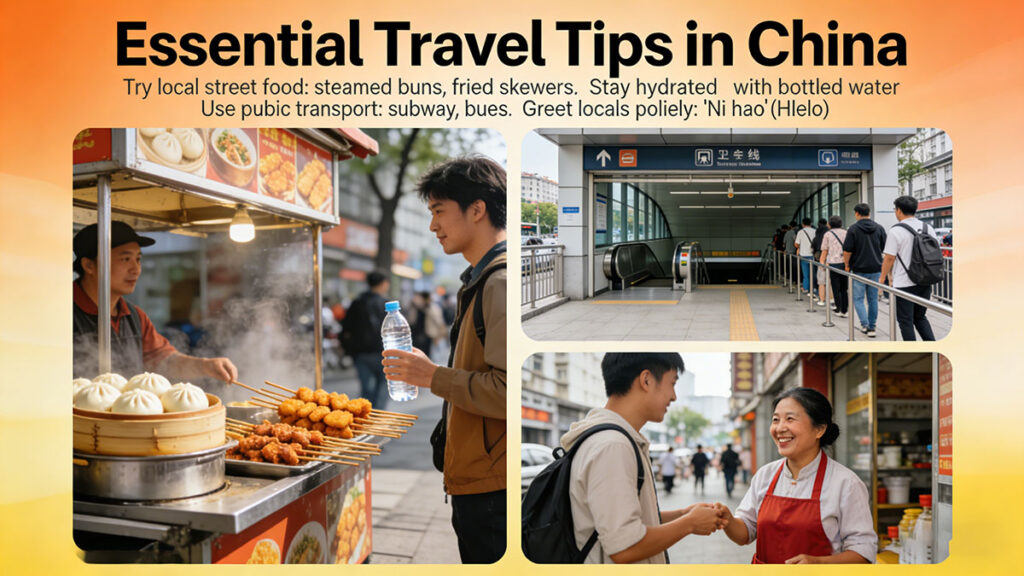
- Tap water is not safe to drink directly. Use bottled or boiled water.
- Follow no-smoking and no-photography signs in public areas.
- Note that some international apps may not work normally in mainland China.
【Conclusion】
Overall, China offers a wonderful mix of history, culture, nature, and modern convenience.
With the right preparation — including proper entry documents, useful apps, and basic local knowledge — you can enjoy a comfortable and unforgettable trip.
No matter whether you love ancient sites, delicious food, beautiful landscapes, or busy modern cities, China has something special for every traveler.
【Frequently Asked Questions (FAQ)】
Q1: Do foreigners need a visa to travel to China?
Most foreign travelers need a valid tourist visa.
However, citizens from some countries may qualify for the 240-hour transit visa exemption.
Q2: Can I use Alipay with a foreign credit card?
Yes. Alipay supports international Visa and Mastercard for payments in most shops, restaurants, and transportation.
Q3: Is tap water safe to drink in China?
No. Tap water is not safe to drink directly.
Therefore, you should use bottled water or boil water before drinking.
Q4: What apps do I need when traveling in China?
You will need payment apps, navigation apps, translation apps, and a local data plan for the best experience.
Q5: Do I need to tip in restaurants or hotels in China?
No. Tipping is not a local custom in China.
Instead, politeness and a smile are the best way to show appreciation.